Tuesday, October 5, 2010

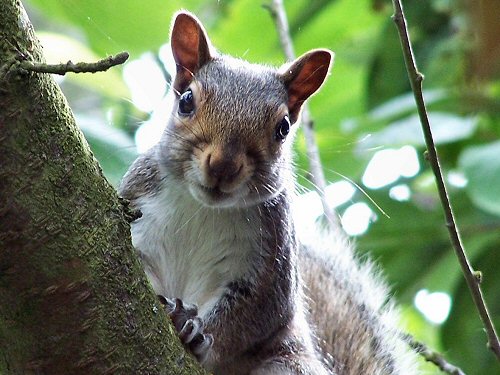
A Story Of 2 Squrriels...


Meet 2 of my favorite furry
"wet weather friends"
I adopted them in the rain ...


Meet Fearless


And The Beaver


A Game Of Peanuts In Shells!


We had a little contest to see which one would come back for the last peanut in the rain Tuesday .

Fearless won this little contest. Hey life is a game of nuts!

And so I enter it into Survival Journals as a lesson for us all
Rain Or Shine, Prepare for the inevitable winter periods in our lives. Be hard working , smart and determined as Fearless and the Beaver!

Fearless and The Beaver are survivors. And they peek thru the glass door,fur soaked, they didn't care if it was raining, they were going to get more nuts. They are not fair weather friends thats for sure. And I didn't disappoint them.

I made sure that there was always a peanut waiting for them. and Fearless and Beaver continued coming back in the rain and
they never gave up, till it got dark. Update:they were back 7am the next morning ready for nuts!

In my wild imagination, I imagine that they had the hope that maybe just maybe I left them another nut. And they fought their way back thru the rain and then were rewarded.

We developed a circle of trust.
Just 2 squirrels preparing for a
cold winter.
The
Survival Instinct


And then Tiger showed up...when my Mainecoon went outdoors the squirrels were not
scared off, my cat Tiger II stood by while the squirrels gathered nuts.

The squirrel never attacked Tiger II and Tiger II was in no mood for fight with this squirrel. Beaver ran over and got the
nut and didn't pick a fight. And Tiger was smart enough to stay calm. We can learn a lesson from these 2 squirrels.

And in the spring this little Baby Robin came to visit

.

Sunday, October 3, 2010

Roy Halliday No Hitter And The Strange But True...Dock Ellis LSD Pitches No Hitter!


Robbin Williams And Doc Ellis Story


Dock Phillip Ellis, Jr. (March 11, 1945 – December 19, 2008) was a Major League Baseball player who pitched for the Pittsburgh Pirates, among other teams. His best season was 1971, when he won 19 games for the World Series champion Pirates and was the starting pitcher for the National League in the All-Star Game. However, he is perhaps best remembered for throwing a no-hitter in 1970 and later stating that he had done it while under the influence of LSD.

As Ellis recounted it:

I can only remember bits and pieces of the game. I was psyched. I had a feeling of euphoria. I was zeroed in on the (catcher's) glove, but I didn't hit the glove too much. I remember hitting a couple of batters and the bases were loaded two or three times. The ball was small sometimes, the ball was large sometimes, sometimes I saw the catcher, sometimes I didn't. Sometimes I tried to stare the hitter down and throw while I was looking at him. I chewed my gum until it turned to powder. I started having a crazy idea in the fourth inning that Richard Nixon was the home plate umpire, and once I thought I was pitching a baseball to Jimi Hendrix, who to me was holding a guitar and swinging it over the plate. They say I had about three to four fielding chances. I remember diving out of the way of a ball I thought was a line drive. I jumped, but the ball wasn't hit hard and never reached me.[6]

The incident inspired the songs "Dock Ellis" by indie rock singer Barbara Manning, "America's Favorite Pastime" by folk singer Todd Snider, "Dock Ellis' No-No" by Chuck Brodsky,[7] and "LSD (The Ballad of Doc Ellis)" by Boston rock band Random Road Mother. Robin Williams has incorporated the tale into a standup routine for HBO [8] An animated short film about the game, "Dock Ellis and the LSD No-No", features narration in Ellis's own voice, taken from a 2008 radio interview.[9]

Source


Not even Halladay was prepared for no-hitter Oct 6th 2010

Roy Halladay came to Philadelphia for the chance to make it to the postseason. All he did Wednesday night was make postseason history.

On a chilly night, through a three-inning rainfall, the big bearded righthander they call "Doc" threw just the second postseason no-hitter in Major League Baseball's long history. Halladay allowed just one Cincinnati Red to reach base. That walk was all that kept him from equaling Don Larsen's 1956 World Series perfect game.

Halladay, who threw a perfect game himself back on May 29, created another indelible baseball memory for a team and a city that have had so much to celebrate the last several Octobers. By dominating the Reds, the champions of the National League's Central Division, Halladay gave the Phillies a 4-0 victory in Game 1 of this best-of-five NL division series.

And it was the focus on that, on winning an important playoff game, that allowed Halladay to wave off the building pressure of his no-hit, no-run performance. He even drove in one of the Phillies' runs with a hit.

"It's something I wasn't real worried about achieving," Halladay said of the no-hitter. "I think if you're not putting too much emphasis on trying to throw a no-hitter, you're going out and staying aggressive. It makes it a lot easier."

His teammates and the sellout crowd at Citizens Bank Park were feeling the pressure for him. As the game wore on - as the number of outs remaining dwindled to nine, then six, then three - the Phillies' dugout grew quieter while the frenzied towel-waving fans grew louder and more excited.

"About the sixth inning, it got real quiet," Phillies manager Charlie Manuel said. "People stayed in their seats and sat there and watched the game. [Halladay] came in and went down to the end of the dugout, sat in his chair, and didn't say a word. End of the inning, he'd get back up and go back on the field. It's pretty neat, really."

Out in the bullpen, the relief pitchers also stayed put. No one wants to change the energy or put a jinx on a pitcher with a no-hitter. One reliever needed to relieve himself, but Ryan Madson said he had remained in place until Halladay secured the final out.

The Phillies are in the postseason for the fourth consecutive October, and the ballpark had been louder only a handful of times before: when Brad Lidge got the final out of the 2008 World Series and after a couple of other series-clinching wins.

The quiet of his teammates didn't pierce Halladay's otherworldly focus. The sonic boom of the fans did.

"When it gets that loud," he said, "it's hard to ignore. I thought especially the last three innings, it seemed like it got louder every inning. It was a lot of fun."

The day started normally enough. Halladay got to the ballpark at his usual time. He said he had tried to treat his first postseason start as a normal workday, to "disconnect yourself from the emotions a little bit." Shortstop Jimmy Rollins, who usually says a few words to Halladay, decided not to before this game.

"I said, 'Roy looks like he's in a different world right now,' " Rollins said.

What a world it turned out to be. Halladay was so good, so nearly mechanical, that there was little of the usual drama that surrounds a no-hitter. He issued his only walk in the fifth inning to Reds outfielder Jay Bruce. The only truly hard-hit ball, a line drive off the bat of relief pitcher Travis Wood, was caught by rightfielder Jayson Werth.

Rollins made two solid plays, making one throw from deep in the hole at short and scooping up a ball that ticked off the mound and changed its angle.

But Halladay was the story. He got through the heart of the Reds' lineup in the seventh, then got three outs, including two strikeouts, on just seven pitches in the eighth inning. When he came out for the ninth, the crowd was on its feet, rally towels fluttering. With each out, the stadium shook.

Ramon Hernandez popped out to Chase Utley. Miguel Cairo hit a foul pop-up toward the third-base side. Wilson Valdez drifted under it and caught it with two hands, as if it were a baby dropped from a burning building. That brought up Brandon Phillips, the Reds' speedy leadoff hitter.

Phillips hit a ball that traveled no farther than his bat. Catcher Carlos Ruiz made the best defensive play of the night, ending the game and the suspense by throwing Phillips out from his knees.

Ruiz rushed out to hug Halladay. Ryan Howard, who caught the final outs of both of Halladay's 2010 classics, stretched his big arms and embraced them both. Soon the rest of the team was celebrating near the mound.

A fan held up a sign, "Welcome to Doctober." Halladay's wife and kids celebrated in the stands. Fireworks filled the South Philly sky.

Roy Halladay, one of the greatest pitchers never to have pitched in the postseason, had delivered one of the greatest postseason pitching performances ever.

"You want to share things like this with family and friends," Halladay said. "My family's here, and I feel like my friends are on the team."

He made a few million more friends Wednesday night.


Friday, October 1, 2010

The new Earth: Why you will never live there


Before you start using aerosol hairspray, let’s try and figure out if anyone can actually live on Gliese 581g.

Here’s the first problem with the new, potentially habitable Earth-like planet just discovered by astronomers. The name. No one’s going to schlep all their stuff to a place called Gliese 581g. Before that sinks in, we need to change the name to something catchier – like “Mars.”

Gliese 581g is about three times the mass of Earth. It’s closer to its star than we are to the sun, but its star is a slow-burning red dwarf, so it’s unlikely we’d be cooked right off it. It sits in what astronomers called the “Goldilocks Zone” of the galaxy – the place where conditions are just right to ensure a supply of liquid water.

We can think of Gliese 581g as our special nest egg, our survival back-up plan. Once we ruin this planet (and rest assured, that’s as good as done), we now have a destination in mind. This is about as likely as you saying, “Once I’ve totally trashed my mom’s basement, I’ll move into Buckingham Palace,” but dreams are important.

However, it’s also important that we understand the sacrifices we’ll be making on Gliese 581g. You’re going to have to give up certain things in order to breathe the (possibly deadly) fresh air. Here they are:

Your current life: Gliese is 20 light years away. That’s about 190,000,000,000,000 km. That’s a lot.

The fastest man-made object is the Helios 2 space probe, which can travel at 250,000 km/h. The upshot – it’s going to take 87,000 years to get there. So you won’t be moving planets, although if you’re super-talented, some form of DNA goo that resembles you might make it there in a petri dish.

Jogging: Gravity is a crap-shoot on Gliese. But in all likelihood, once you leave the house, you will either be crushed as flat as a crepe or go spinning off into the ether. Neither of which is much of an aerobic workout.

Skin: Like the moon, Gliese always shows the same face to its star. So one side is bathed in light – and likely baking hot – while the other side is swathed in darkness – and likely freezing.

Either way, your epidermis is not going to cut it. So prepare to start every day with some variation on this ritual.

The novelty of your birthday: Gliese rotates once every 37 days – which means “hump day” on Gliese is going to last longer than July.

Coincidentally, that’s also as long as it takes Gliese to orbit its star. So one year is also 37 days. That means it’ll be your birthday every day at 3:30 p.m. And no, you don’t get to take your birthday day off.

The next time you spot an oil slick, resist the urge to light it on fire, no matter how much fun that seems like. Sounds like we’re going to need our beater of a homeworld for a little while yet.

Or will we?

“The fact that we were able to detect this planet so quickly and so nearby tells us that planets like this must be really common,” said one of Gliese 581g’s discoverers, astrophysicist Steven Vogt.

Whew. Awesome news. No need to rush. So. How long were they looking before they spotted Gliese 581g? Three days? A week?

Actually, 11 years.

No word yet on the rumour that Prof. Steven Vogt has been en

gaged since 1978.