Showing posts with label obama. Show all posts

Wednesday, October 31, 2012

Bush Vs Clinton Clinton Wins - So Romney says NO to Bush Support!

"We have had two great economic experiments in America over the last 30 years. One succeeded. The other failed -- in fact, it was a man-made disaster" Clinton Success and Bushes Failures.


Earlier this week -- as he was barnstorming the country for Barack Obama -- former President Bill Clinton subbed in for the president as Obama flew back to Washington to oversee the country's response to a major hurricane.
That would seem an appropriate context to ask the question, why hasn't the most recent Republican President, George Bush, been barnstorming the country for Mitt Romney?
It says a lot that for most Americans this sounds like an absurd question.
Clinton was a major featured speaker at the Democratic Convention. Bush wasn't even invited to Tampa.
Bush is not campaigning for Romney because he and the policies he implemented are politically radioactive to most American voters.
George Bush is off in political Siberia because the Romney campaign is doing everything humanly possible to prevent voters from realizing that Romney intends to return precisely those same failed Bush policies to the White House if he is elected president next week.
Let's start with the matter that is uppermost in the country's attention -- the hurricane.
It's fair to say that his response to Hurricane Katrina was not Bush's finest hour. But Bush's failure to respond quickly and effectively to Katrina was not simply a reflection of his administration's incompetence. It was a reflection of the fact that his administration didn't believe in government.
Natural disasters make people remember why it is so important that we have a society where we have each other's back. They make us remember that government is the name we give to the things we choose to do together.
Natural disasters like Hurricane Sandy make us remember why the law of the jungle -- why a self-centered, irresponsible, unbridled focus on you and you alone -- isn't what we learned in Sunday School.
Even far right New Jersey Governor Chris Christie reprimanded New Jersey citizens who refused to evacuate low-lying areas because they would put the lives of first responders at risk -- because they had a responsibility to each other.
Bush -- and his response to Katrina -- exemplified the right wing's failure to understand that most Americans believe in a society where we are all in this together, not all in this alone.
And Mitt Romney completely shares Bush's view. Romney actually proposed eliminating the Federal Emergency Management Administration (FEMA) and hand over responsibility for response to disasters to the states. Romney ignores that when disaster strikes, we are Americans first. We have each other's back whether we are from Mississippi or New Jersey. We do that because it's right. We also do it because while disaster may strike our neighbors in New Jersey today, it could strike those of us who live in Illinois tomorrow.
But of course there are many other reasons why the Republicans have failed to ask George Bush to campaign for their presidential ticket. Two stand out.
We have had two great economic experiments in America over the last 30 years. One succeeded. The other failed -- in fact, it was a man-made disaster.
The first was led by President Bill Clinton. Clinton believed that you grow the economy from the middle out -- not the top down. He understood that businesses don't invest and hire unless there are customers out there with money in their pockets -- that they are the "job creators" -- not a bunch of hedge fund managers on Wall Street.
Clinton proposed a federal budget that would eliminate the deficit mainly by calling on the wealthiest Americans to pay a little more in taxes -- and by investing in infrastructure and education to grow the economy. And Clinton forcefully defended programs like Medicare when Newt Gingrich wanted to cut them to give tax cuts to the rich.
When his budget was debated in Congress, Republicans predicted it would lead to massive job losses and recession.
The Republicans were dead wrong. Clinton presided over the most prosperous period in human history -- literally. On his watch the economy experienced robust growth and created 22 million new American jobs. Clinton eliminated the Federal deficit and left his successor with budget surpluses as far as the eye could see.
Then came George Bush. He cut taxes for the rich -- arguing that this would turbo-charge job growth and that the deficit would take care of itself. In fact, Bush's Vice President Dick Cheney -- a man who has also been noticeably absent from the campaign trail this fall -- famously said that "deficits don't matter."
The result: Bush left office having presided over the worst record of job growth since the Great Depression -- zero net private sector jobs created; that's right, zero.
Worse, his failure to regulate Wall Street set the stage for the worst financial collapse since the Great Depression, costing eight million Americans their jobs, wiping out 40 percent of many people's pensions, collapsing of the housing market, and causing the worst economic downturn in 60 years.
Bush's trickle-down tax policies not only failed to create economic growth -- they left the Federal Government saddled with more debt than all of the previous presidents had racked up since the beginning of the Republic. And remember, that debt load made it even harder for President Obama to clean up the economic mess once he came into office in 2009.
It's not surprising, then, that you don't see George Bush on the stump trying to convince Americans that Mitt Romney's economic policies will create a better life for the middle class. Of course he could step in for Mitt, he certainly knows the script -- in fact he wrote the script.
After all, Mitt Romney is promoting exactly the same economic policies that Bush used to create zero private sector jobs, crash the economy and run up the deficit just a few short years ago.
But there's more. You don't see George Bush campaigning for Romney because most Americans think his foreign policy was another man made catastrophe. Bush led us into two wars -- which by the way he paid for on the nation's credit card -- and alienated America from the rest of the world.
He intentionally lied about the rationale for the War in Iraq -- convincing the American people that Saddam Hussein had weapons of mass destruction, when he had none. The War in Iraq cost thousands of American lives and left tens of thousands injured or disabled. Some economists think it may ultimately cost up to three trillion dollars to the American economy -- money that could instead have been spent building schools and roads and bridges and investing in jobs in the United States.
Bush's go-it-alone, bull in a china closet foreign policy alienated people around the world, stretched the American military and left America weaker. And the pictures of humiliation at Abu Ghraib -- his policies of torture and rendition and lack of respect for the rule of law -- created recruiting posters for our enemies.
Bush doesn't campaign for Romney because the Romney campaign has zero interest in focusing the attention of the voters on the fact Romney is surrounded by exactly the same gang of foreign policy advisers that presided over the War in Iraq. In addition they both share the same credentials: Both had zero foreign policy experience before they ran for president.
The fact is that if you liked the War in Iraq, you'll love the Romney foreign policy. So for the next six days, every time you hear about Bill Clinton campaigning for President Obama, let that be a reminder of the guy you won't see out their campaigning for Mitt Romney.
The choice is clear. If you liked the way things were going under George Bush, vote for Mitt Romney. But if you want long-term economic growth, if you believe in defending the middle class, if you don't want to go back to the policies of George Bush -- vote to reelect President Barack Obama.

Robert Creamer is a long-time political organizer and strategist, and author of the book: Stand Up Straight: How Progressives Can Win, 

Romney ads are so offensive because it is a bald-faced lie. And he knows it's a lie.


Apart from the storm news, there has been some political news that I cannot let go of.
Mitt Romney must realize that he has lost the industrial Midwest because he's completely lost a grip on reality. He's decided to throw a Hail Mary pass that will cause his already-struggling campaign to implode in Ohio.
Last week, Romney falsely claimed, "Jeep, now owned by the Italians, is thinking of moving all production to China."
When Romney said that, Chrysler responded by calling the statement "a leap that would be difficult even for professional circus acrobats" to suggest that it would close U.S. facilities and move all operations to China. In fact, Chrysler is hiring over 2,000 more people in Toledo and Detroit.
But Romney decided to double down on the deception. The campaign is running the ad in the video below in select Ohio markets.

Chrysler had this response to the ad: "Jeep has no intention of shifting production of its Jeep models out of North America to china." Sergio Marchionne, the CEO of Chrysler, sent an email to employees today again expressly stating that Chrysler is absolutely not sending jobs to China.
The Washington Post's Fact Checker gave the ad four Pinocchios -- you can't get rated any more deceptive than that.
President Obama's campaign ran this response to the ad.
And then, Romney's campaign did it again! But this time it wasn't Chrysler - now they're paying for a radio ad saying the same thing about General Motors.
Which caused GM to issue this statement:
We've clearly entered some parallel universe during these last few days, no amount of campaign politics at its cynical worst will diminish our record of creating jobs in the U.S. and repatriating profits back to this country.
The Romney ads are so offensive because it is a bald-faced lie. And he knows it's a lie. But because Romney is such a desperate, opportunistic, single-minded politician, he doesn't care that he's lying.
It's his scorched earth policy -- he'll do whatever it takes to win, no matter what the consequences to our politics, our country, or our people.
It's what Leo Gerard, international president of the United Steelworkers, yesterday called "winning without honor." I'm not sure that even goes far enough.
Ohioans aren't going to be fooled by this deception. Here's how the Cleveland Plain Dealer put it: "It won't work. Ohio voters know who stepped up when the auto industry was at the abyss -- and it wasn't Romney."
Let me say this to the people of Ohio -- I can understand why you'd be ticked off. Mitt Romney is lying to you because he thinks you're too oblivious to remember the truth,
Unfortunately, neither you nor I can respond with the choice words we might like to use. But fortunately we can send an even more powerful response to this garbage. You'll have the final word, in one week. On election day.


Michael Brown, Of 'Heckuva Job' Fame, Says Obama Reacted Too Fast To Hurricane Sandy


Michael Brown, the former FEMA director infamously praised by President George W. Bush for doing a "heckuva job" during the aftermath of Hurricane Katrina in 2005, told a local paper that President Barack Obama acted too quickly in mobilizing relief for Superstorm Sandy.
"Here's my concern," Brown told Denver's Westword on Monday, suggesting that the official response was actually making people complacent. "It's premature [when] the brunt of the storm won't happen until later this afternoon."
Obama declared states of emergency all along East Coast states in the path of Sandy on Sunday, well before the storm hit, allowing federal resources to start flowing where governors thought they would be needed. FEMA and local responders were able to pre-position a lot of the material being drawn upon now.
Obama also held a press conference warning people to pay careful attention to the storm.
"This is a serious and big storm," Obama said after meeting with FEMA officials and talking to governors Sunday. "And my first message is to all the people across the Eastern seaboard, Mid-Atlantic, going north, that you need to take this very seriously."
Brown suggested Obama was just trying to look good.
"He probably figured Sunday was a good day to do a press conference," Brown said in his interview.
He also thought Obama's response contrasted poorly to his response to the deadly attacks on the American consulate in Benghazi, Libya, in which the U.S. ambassador and three others died. "One thing he's gonna be asked is, why did he jump on this so quickly and go back to D.C. so quickly when in ... Benghazi, he went to Las Vegas?" Brown said.

Monday, October 22, 2012

Romney VS Obama - NFL Style Referee Needed!

By Dan Turner October 22, 2012, 4:30 a.m.

About the best thing that can be said about Monday's presidential debate in Boca Raton, Fla., is that it's the last one. In theory, debates should represent a terrific opportunity for voters to assess the competing arguments and policies of presidential candidates. It's a nice theory, but that's not what we were presented with Tuesday night, nor in the first debate.

What I heard, over and over again, was a lot of barking: One candidate barks out statistics or obscure references to his opponent's record or statements, followed by return barking to the effect that it's all a pack of lies. Sometimes they even bark over each other, such as the embarrassing exchange Tuesday between President Obama and Mitt Romney over whether oil drilling on public lands had increased or decreased during Obama's tenure.

 Was anyone edified by this? I doubt it. Republicans came away sure that Romney was telling the truth, Democrats equally certain that Obama was the honest one, and undecided voters were most likely pondering a move to Canada.

Source

Tuesday, October 16, 2012

Bill Clinton blasts Mitt Romney over proposed tax cut lies


8:55AM EDT October 16. 2012 - Bill Clinton is going to bat again for President Obama, cutting a video blasting Mitt Romney over his proposed tax cut.
Clinton says Romney's tax cut proposal adds up to $5 trillion, and can only add to the national debt unless they are accompanied by massive budget cuts or the elimination of tax deductions that benefit the middle class.
The tax cut issue is very likely to surface in tonight's second Obama-Romney debate.
"In the first debate," Clinton says in the video, "Governor Romney said that he wasn't really going to cut taxes on upper income people -- he only wanted to cut taxes for middle class people. That's not true."
In a statement accompanying the video, the Obama campaign says: "President Clinton explains Mitt Romney's $5 trillion tax cut and how middle class families with children will get an average tax increase of $2,000 to pay for $250,000 in tax cuts for multi -millionaires."
Romney says his proposed tax cut will not add up to $5 trillion because it will be offset by eliminating tax deductions and loopholes. He also notes that Obama wants to raise taxes by eliminating George W. Bush-era tax rates for Americans making more than $250,000 a year.
Responding to the Clinton video, Romney spokesperson Amanda Henneberg said:
"They are trying to hide the fact that President Obama is the only candidate running on a plan to increase taxes. In tonight's debate, the choice on taxes will be clear. President Obama wants to raise taxes on small businesses and job creators, which will make our recovery even more difficult. Mitt Romney will lower tax rates across the board, make our businesses more competitive, and bring a real recovery to the American people."

The Source

Sunday, September 9, 2012

Paul Ryan's lies were so blatant that they had the media...scrambling


Even Fox News, which rarely has a bad comment about Republicans and conservatives, criticized Ryan's speech as "an apparent attempt to set the world record for the greatest number of blatant lies and misrepresentations slipped into a single political speech," according to commentator Sally Kohn.
It's no shock to learn that our presidents lie. Nixon did it. Clinton did it. And George W. Bush did it. What is shocking is that they are so easily forgiven, or that we so easily forget.
You'd think, though, that we might expect, and get, a bit more honesty from the candidates running for president. I mean, if you know somebody's a liar when he's still trying to win votes, you have to wonder what will happen if he's elected.

Granted, just about everybody tells little white lies now and then, often with honorable motives such as not hurting other people or saving them or ourselves an embarrassing moment. But lying to millions of people is different.

President Nixon did it to save himself from being connected to the Watergate cover-up. President Clinton wanted to avoid the embarrassment of people knowing he had a sexual encounter with a White House intern. President Bush lied to justify a war that resulted in the deaths of hundreds of thousands of people.

The impacts were certainly different, but they all lied.

And
so did Rep. Paul Ryan, vice-presidential candidate, during his speech last week at the Republican National Convention. His motive was to try to discredit President Obama, who along with presidential candidate Mitt Romney, also has been caught stretching the truth on occasion.

Ryan's lies were so blatant that they had the media and commentators scrambling to find other words for them, such "political dishonesty" and "deceptive statements," because the falsehoods were stated with millions of witnesses.

But whatever you call it, a political convention venue should not be justification for dishonesty and deception _ and certainly not outright lies.

By now, you've likely heard some of the examples of Ryan's untruthfulness: Blaming Obama rather than Bush for the closing of a GM plant; blaming Obama instead of Bush and the Republicans for exorbitant deficits and the U.S. credit downgrade; and saying that the GOP ticket would "make the safety net safe again" when Ryan's own budget plan would slash social programs.

Jonathan Cohn, writing on The New Republic website, may have had the best reaction.

"Think of it this way," he wrote. "A Martian who came down to Earth and heard Ryan speak last week would conclude that Obama had abandoned the auto industry; that Romney and Ryan would never cut spending from Medicare; that Obama is to blame for high deficits and the credit downgrade; and that Romney and Ryan are out to save the safety net. This poor Martian would have it exactly backwards."

Even Fox News, which rarely has a bad comment about Republicans and conservatives, criticized Ryan's speech as "an apparent attempt to set the world record for the greatest number of blatant lies and misrepresentations slipped into a single political speech," according to commentator Sally Kohn.
Read more here...

Wednesday, August 1, 2012

Reposted:Tom Harper: Was Christ's life based on pagan myths?


Comment: Was Christ's life based on pagan myths?

By W. Ward Gasque

WHEN I first met Tom Harpur just over 30 years ago, he was teaching New Testament studies at Toronto's Wycliffe College. Shortly thereafter, he left the ivory tower to become, in due course, Canada's best-known religious journalist. Since then, he has written 17 books, and several thousand articles and columns; he has also achieved high visibility as a radio and television commentator.

To say that his religious views have changed over the years would be a gross understatement. In 1970, he was an evangelically committed Anglican priest, preparing students to faithfully preach and teach the doctrines of Christianity as understood by the classic creeds of the church. 

Today, his understanding of God, the world, and salvation seems to be that of a theosophist or a neo-gnostic -- though he continues to consider himself a Christian.


The Pagan Christ (Thomas Allen, 2004) is Harpur's story of his discovery of the writings of Alvin Boyd Kuhn (1880-1963), Godfrey Higgins (1771-1834) and Gerald Massey (1828-1907) -- who argued that all of the essential ideas of both Judaism and Christianity came primarily from Egyptian religion. Their thesis was that, toward the end of the third Christian century, the leaders of the church began to misinterpret the Bible.

Prior to this time, Kuhn and company maintained, no one had ever understood the Bible to be literally true, and the narrative material of the Hebrew and Greek Bible had been interpreted as symbol or myth; first among these myths was the concept of the incarnation -- i.e. that God resided within every "fully realized spiritual human being." According to this theory, the leaders of what became Christian orthodoxy made a tragic mistake by identifying this religious experience with a historical event: namely, the birth, life and ministry of Jesus of Nazareth.

According to Harpur, there is no evidence that Jesus of Nazareth ever lived. Drawing especially on the writings of Kuhn, he claims that virtually all of the details of the life and teachings of Jesus have their counterpart in Egyptian religious ideas; he also maintains that there are strong parallels between Christ's life and Greek, Hindu and Buddhist myths.

Harper does not quote any contemporary Egyptologist or recognized academic authority on world religions, nor does he appeal to any of the standard reference books, such as the magisterial three volume Oxford Encyclopedia of Ancient Egypt (2001) or any primary sources. Rather, he is entirely dependent on the work of Kuhn, who he describes as "the most erudite, most eloquent, and most convincing . . . of any modern writer on religion I have encountered in a lifetime dedicated to such matters."

Who is Alvin Boyd Kuhn? He, along with Higgins and Massey, is given the title 'Egyptologist,' and is regarded by Harpur as "one of the single greatest geniuses of the twentieth century . . . [towering] above all others of recent memory in intellect and his understanding of the world's religious." Kuhn, he writes, "has more to offer the Church than all the scholars of the Jesus Seminar together. More than John Spong . . . C.S. Lewis . . . Joseph Campbell or Matthew Fox. I remain stunned at the silence with which his writings have been greeted by scholars."

As it turns out, Kuhn was a high school language teacher who earned a PhD from Columbia University by writing a dissertation on Theosophy. A prodigious author and lecturer, he had difficulty finding a publisher for his works; most of them were self-published. His only link with an institution of higher learning was a short stint as the secretary to the president of a small college.

I sent an email to 20 of the world's leading Egyptologists, outlining the following claims put forth by Kuhn (and hence Harpur):

* That the name of Jesus was derived from the Egyptian "Iusa," which means "the coming divine Son who heals or saves".

* That the god Horus is "an Egyptian Christos, or Christ.... He and his mother, Isis, were the forerunners of the Christian Madonna and Child, and together they constituted a leading image in Egyptian religion for millennia prior to the Gospels."

* That Horus also "had a virgin birth, and that in one of his roles, he was 'a fisher of men with twelve followers.'"

* That "the letters KRST appear on Egyptian mummy coffins many centuries BCE, and . . . this word, when the vowels are filled in, is really Karast or Krist, signifying Christ."

* That the doctrine of the incarnation "is in fact the oldest, most universal mythos known to religion. It was current in the Osirian religion in Egypt at least four thousand years BCE."

Only one of the 10 experts who responded to my questions had ever heard of Kuhn, Higgins or Massey! Professor Kenneth A. Kitchen of the University of Liverpool pointed out that not one of these men is mentioned in M. L. Bierbrier's Who Was Who in Egyptology (1995), nor are any of their works listed in Ida B. Pratt's very extensive bibliography on Ancient Egypt (1925/1942). Since he died in 1834, Kitchen noted, "nothing by Higgins could be of any value whatsoever, because decipherment of the Egyptian hieroglyphs was still being finalized, very few texts were translated, and certainly not the vast mass of first-hand religious data."

Another distinguished Egyptologist wrote: "Egyptology has the unenviable distinction of being one of those disciplines that almost anyone can lay claim to, and the unfortunate distinction of being probably the one most beleaguered by false prophets." He goes on to refer to Kuhn's "fringe nonsense."

The responding scholars were unanimous in dismissing the suggested etymologies for Jesus and Christ. Professor Peter F. Dorman, of the University of Chicago, commented: "It is often tempting to suggest simplistic etymologies between Egyptian and Greek (or other languages), but similar sequences of consonants and/or vowels are insufficient to demonstrate any convincing connection."

Ron Leprohan, of the University of Toronto, pointed out that, while "sa" means "son" in ancient Egyptian and "iu" means 'to come," Kuhn/Harpur have the syntax all wrong. In any event, the name 'Iusa' simply does not exist in Egyptian. The name 'Jesus' is a Greek derivation of a Semitic name ("Jeshu'a") borne by many people in the first century.

While the image of the baby Horus with Isis has influenced the Christian iconography of Madonna and Child, this is where the similarity stops. The image of Mary and Jesus is not one of the earliest Christian images, and, at any rate, there is no evidence for the idea that Horus was virgin born. And the New Testament Mary was certainly not a goddess (like Isis).

There is no evidence for the idea that Horus was 'a fisher of men' -- or that his followers, the King's officials, were ever 12 in number. KRST is the word for "burial" ("coffin" is written "KRSW"), but there is no evidence whatsoever to link this with the Greek title "Christos" or the Hebrew "Mashiah".

There is no mention of Osiris in Egyptian texts until about 2350 BC; so Harpur's reference to the origins of Osirian religion is off by more than a millennium and a half. Elsewhere, Harpur refers to "Jesus in Egyptian lore as early as 18,000 BCE"; and he quotes Kuhn as claiming that "the Jesus who stands as the founder of Christianity was at least 10,000 years of age." In fact, the earliest extant writing that we have dates from about 3200 BCE.

Kuhn/Harper's redefinition of "incarnation," and their attempt to root this in Egyptian religion, is regarded as bogus by all the Egyptologists I consulted. According to one: "Only the pharaoh was believed to have a divine aspect, the divine power of kingship, incarnated in the human being currently serving as the king. No other Egyptians ever believed they possessed even 'a little bit of the divine'."

Virtually none of the alleged evidence for the views put forward in The Pagan Christ is documented by reference to original sources. The notes refer mainly to Kuhn, Higgins, Massey or some other long-out-of-date work. Very occasionally, there is a reference to a more contemporary work of scholarship, but this often has little or nothing to do with the point made.

Very few of the books listed in the bibliography are recent. Works that are a century or more old are listed by the date of the most recent edition. The notes abound with errors and omissions. If you look for supporting evidence for a particular point made by the author, it is not there. Many quotations are taken out of context and interpreted in a very different sense from what their author originally meant (especially the early church fathers).

Harpur's book is chock full of questionable claims, such as:

* That prior to the fourth century "it was believed that the coming of the Messiah, or Christ, was taking place in the life of every person at all times."

* That "Christianity began as a cult with almost wholly Pagan origins and motivations in the first century."

* That nearly all of the most creative leaders of the earliest church were pronounced heretics and reviled by "those who had swept in and grabbed control of [church] policies."

* That "the mystical/allegorical method of interpreting the sacred Scripture . . . was replaced by a wholly literal/historical approach" (presumably, in the fourth century).

* That "apart from the four Gospels . . . and the Epistles, there is no hard, historical evidence for Jesus' existence coming out of the first century at all."

* That Albert Schweitzer "concluded that there was no traditional Jesus of Nazareth as a historical person."

* That "Paul's Jesus lacks any human quality for the very reason that, in Paul's understanding, he was not a human person at all."

According to Harpur, Christian scholars have a vested interest in maintaining the myth that there was an actual Jesus who lived in history. First, he insists, there was "the greatest cover-up of all time" at the beginning of the fourth century; and thousands of Christian scholars are now participants in this on-going cover-up.

This perspective misses the fact that, for several generations, there have been professors of religious and biblical studies who are Jewish, Unitarian, members of every Christian denomination -- and many of no professed religious persuasion. And there are no religious tests for chairs in Egyptology. Presumably, the Jewish, Unitarian, secular and many very liberal Christians who happen to be recognized scholars have no axes to grind regarding whether or not Jesus actually lived, or whether most of the ideas found in the Bible stem from Egyptian or other Near Eastern religion.

If one were able to identify all of the non-Christian members of the major learned societies dealing with antiquity, it would be unlikely that you could find more than a handful who believe that Jesus of Nazareth did not walk the dusty roads of Palestine in the first three decades of the Common Era. Evidence for Jesus as a historical personage is incontrovertible.

Rather than appeal to primary scholarship, Tom Harpur has based The Pagan Christ on the work of self-appointed 'scholars' who seek to excavate the literary and archaeological resources of the ancient world the same way an avid crossword puzzle enthusiast mines dictionaries and lists of words.

W. Ward Gasque is a co-founder of Regent College in Vancouver, and a historian of early Christianity.

Related stories:

No historical evidence of Jesus
Ever since the publication of The Pagan Christ, literalist clergy and others have been hammering away at the theme of the alleged historicity of the Gospels. Yet, Bible scholars today know that the Gospels never were historical biographies even though they may appear to be such.
Tom Harpur, Toronto Star, May 16

Tuesday, July 24, 2012

GOP Republican Jobs Bills Won't Actually Create Jobs, Say Economists


Erin Mershon
Erin Mershon- Huffington Post


WASHINGTON -- House Republicans routinely beat the drum about the hard work they have done in passing "more than 30 jobs bills" that are now before the Democrat-controlled Senate, going nowhere, as the economy gasps for air.
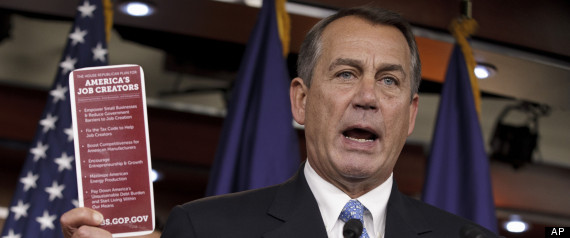
For almost a year, House Speaker John Boehner (R-Ohio) and House Majority Leader Eric Cantor (R-Va.) have plugged their jobs package at every opportunity. They regularly bring it up at press events, during floor speeches and in statements in response to just about anything related to the economy. Boehner even carries aroundin his jacket pocket a 4-by-8-inch card that lists off their jobs bills, and he encourages his members to flash their cards at campaign events.
"President [Barack] Obama and Democrats here in Congress have shown us what doesn't work: more government, more spending, more taxes don't create more jobs," Boehner said at a recent weekly briefing. "We've passed more than 30 jobs bills, including bipartisan bills expanding energy production and projects like the Keystone pipeline."
Cantor plugged the jobs bills -- and nudged Democrats to get on board with the Republican plan -- in response to the June unemployment report. "House Republicans are committed to bold, pro-growth policies and have passed dozens of bills to create jobs," he said in a statement. "We've begun to right the ship, but we will not be able to achieve long-term growth without willing partners in the White House and Senate."
The GOP jobs package, which currently includes 32 bills, represents Republicans' hallmark legislative accomplishment over the past two years. In the months ahead of the election, they will lean on it as proof of two things: that they are not the do-nothing obstructionists that Democrats paint them as, and that they are working hard to address the 8.2 percent unemployment rate.
But there's a problem with their jobs bills: They don't create jobs. At least, they won't any time soon.
In interviews conducted by The Huffington Post with five economists, most said the GOP jobs package would have no meaningful impact on job creation in the near term. Some said it was not likely to do much in the long term, either.


"A lot of these things are laughable in terms of a jobs plan that would produce noticeable improvements across the country in the availability of employment in the next four or five years," said Gary Burtless, a senior economist at Brookings. "Even in the long run, if they have any effect all, it would be extremely marginal, relative to the jobs deficit we currently have."
Mark Zandi, the chief economist at Moody's Analytics, agreed that the bills would have almost no effect on job creation in the short term, though he was slightly more optimistic about their long-term prospects.
"These kind of changes will matter over a period of three to five years," Zandi said. "It takes that long before businesses can digest changes and respond to them."
He noted, though, that legislation as narrowly targeted as the Republican package is unlikely to do much for real job creation.
"For it to show up in a meaningful way in the natural economy, you can make specific changes that could affect a specific industry or a few companies, but it's not going to make a big difference in terms of the monthly job numbers," Zandi said. "It takes some very significant changes across lots of different industries to really make a big difference."
Carl Riccadonna, a senior economist at Deutsche Bank, said some of the bills could create jobs, but that they would amount to more of an afterthought in terms of achieving broader policy goals.
"They are very narrowly targeted, and it gives the impression that maybe some of this is special interest really pursuing these, not really taking a macro view but a very, very micro focus in what the impact would be," Riccadonna said. For most of the bills in the package, "jobs are a second- or third-order effect, not the main priority."
At the heart of the GOP jobs package is a push for rolling back regulations -- and gutting environmental laws that regulate clean air and water -- to spur job growth. The House Republican Conference website makes the argument that deregulation will "remove onerous federal regulations that are redundant, harmful to small businesses, and impede private sector investment and job creation."
But economists told The Huffington Post that regulation has had a minimal impact on the unemployment rate. Their claim is backed by the Bureau of Labor Statistics, which shows that just under 16,000 jobs, or 0.4 percent, were lost because of "government regulations/intervention."
"It's just hard to believe that the paperwork requirements to starting a business represent a major impediment to starting businesses right now," Burtless said. "That's not why we had lots more business creation in the late '90s."
Joel Prakken, chairman of Macroeconomic Advisers, warned that any potential job creation from environmental deregulation could be offset by health concerns.
"If you increase employment but you have a lot more sick people, you have to ask yourself, 'What's the trade-off?'" he said. "The highest level of GDP is not necessarily the highest level of national satisfaction or national health."
Indeed, environmental advocates argue that many of the GOP proposals are more likely to kill people than create jobs.
"It won't save them jobs, it won't even save them that much money, but it is going to cause illnesses, deaths, more hospital stays or days lost because of illness,” said Scott Slesinger, legislative director for the Natural Resources Defense Council. “That's why we have all these environmental laws.”
Not all of the GOP proposals are focused on environmental deregulation. A handful call for weakening the authority of the National Labor Relations Board as a way to boost businesses' savings, which could, in theory, then be reinvested in new jobs.
But Burtless said those proposals are more likely to impact those currently working than those seeking work.
"They may weaken the ability of current workers to negotiate for better working conditions or wages. They may lessen the ability of workers who want to join unions to do so in companies that are currently unorganized," he said. "But it's just hard to believe that they create jobs in the short run."
Even one of the more popular bills in the mix -- a small business tax cut -- won't do much for job creation, some of the economists said. They argued that it's not that businesses need more money for hiring, but that they need a sufficient demand for their products.
"They know that if they hire people to produce more widgets, they won't be able to sell the widgets," Prakken said. "Giving them a tax break just increases their profits," but doesn't encourage hiring.
Riccadonna disagreed. He acknowledged that weak demand is the biggest problem facing businesses, but said the small business tax cut is still the most likely of all the GOP bills to create jobs.
"We should be focusing on small businesses and what we can do to make business conditions more favorable for them, because that's where the real turn in labor market will lie," he said. "So anything that makes life or operating conditions a little bit easier for them, that I would certainly be in favor of. That will have a meaningful jobs impact."
Ultimately, each economist was clear on one point: The GOP package is far more political than practical.
"It's game playing to try to pretend like they're doing something," said Jesse Rothstein, an economics professor at the University of California, Berkeley. "It's silly season, and so they know they have to put up something that has the label 'job creation' on it, whether or not it would work."
Boehner spokesman Michael Steel demurred when asked for a response. He reiterated that Senate Democrats are holding up their job-creation bills.
"The House has passed more than 30 jobs bills that are awaiting action in the Democrat-controlled United States Senate," said Steel. "We have passed a responsible budget that deals with our deficits and debt, a bill to replace the 'sequester,' which would be disastrous for our national security, and ... we will vote to stop the tax hike on every American taxpayer, which is scheduled for the end of this year. In short, we are acting on the American peoples’ priorities: jobs and our economy."
A Cantor spokeswoman did not return a request for comment.
For all their complaints about Senate inaction, Boehner and Cantor regularly fail to point out that the Senate has, in fact, passed nearly a dozen of Republicans' so-called jobs bills in the last two years. Eleven have already become law, and another one has passed the Senate but hasn’t been signed into law yet.
Jennifer Bendery and Michael McAuliff contributed reporting to this article.

House Republicans routinely herald the hard work they have done in passing the 30-some "jobs bills" in the slideshow below, while they antagonize the Senate for its failure to act on the measures. But economists warn that the House-passed bills won't do much to create jobs -- which Senate Majority Leader Harry Reid (D-Nev.) says is the explanation for why the bills have stalled.


Friday, July 6, 2012

GOP Mitt Romney Lies And Fake Facts


Lee A. Saunders


Senator Daniel Patrick Moynihan once famously told an opponent in a debate: "Everyone is entitled to his own opinion, but not his own facts." I was reminded of that last Thursday when former corporate raider Mitt Romney, who made millions out-sourcing American jobs to foreign countries, expressed his opinion on the Supreme Court's decision upholding Obamacare. In just one paragraph of his speech, Romney made six claims that bear no relation to the real world. He created "fake-facts" about health care reform and totally distorted the law's real impact.

 This is an old Karl Rove campaign tactic -- make things up -- on steroids. It needs to be exposed. 1. Romney said Obamacare "cuts Medicare, by approximately $500 billion." This claim is meant to scare seniors, but it is simply false. PolitiFact.com has this to say about this bogus claim: "The bill doesn't take money out of the current Medicare budget but, rather, attempts to slow the program's future growth, curtailing just over $500 billion in anticipated spending increases over the next 10 years."

 Those savings come from a variety of administrative changes and things like requiring Medicare Advantage plans to reduce their inflated costs. The law makes no cuts to guaranteed Medicare benefits. In fact, it increases Medicare benefits by improving the prescription drug benefit and by making cancer screenings and other preventive services available without a co-pay. 2. Romney said Obamacare "raises taxes on the American people by approximately $500 billion." False.

In fact, families across the nation will save money as a result of the Obamacare reforms, such as state-based exchanges that come online in 2014. Families who purchase private health insurance through these exchanges will save up to $2,300 each year on their health care spending. Millions of Americans already see real savings as their out-of-pocket costs go down to zero for preventive care like flu shots or cancer screenings. 3. Romney says Obamacare "adds trillions to our deficits and to our national debt." False. In fact, the non-partisan Congressional Budget Office estimates that Obamacare will reduce the national deficit by $210 billion over the next 10 years. 4. Romney says Obamacare will force up to 20 million Americans to "lose the insurance they currently have." False. Rather than losing insurance, millions of Americans will get insurance for the first time. CBO and the Joint Economic Committee estimate that the number of people without health insurance coverage will be reduced by 30 million to 33 million by 2016 if the states implement the law as intended. 5. Romney says Obamacare is "a job-killer." False.

It takes a lot of nerve for a politician who has endorsed the job-killing agenda of Paul Ryan and the House Republicans to try to label health care reform as a job-killer. In fact, one recent study suggests that the lower growth in health care costs through Obamacare will create 250,000 to 400,000 thousand new jobs in many industries annually throughout the next decade. 6. Romney says "Obamacare puts the federal government between you and your doctor." False.

Obamacare removes the insurance companies from their position between you and your doctor. Remember, under Obamacare, insurance companies can no longer end your health coverage if you become ill or deny you coverage because of a pre-existing condition. And insurance companies will have to spend 80 percent of the money they take in on health care - not on administrative costs or CEO salaries - and refund the money to their customers if they don't meet the target. Before the end of the summer, 12.8 million Americans will receive rebates because their insurance company spent too much of their premium dollars on administrative costs or CEO bonuses.

What Mitt Romney is doing should be clear to everyone. His campaign has done some polling on what people don't like and they have decided to attribute all those things to Obamacare, even when they bear no relation to reality. These are "fake-facts" designed to make an honest debate impossible. They are an insult to the intelligence of the American people and should be repudiated by any American who recognizes the value of a true debate about real facts. It is clear that Romney and his allies have decided not to discuss Obamacare factually.

They know that if they told the truth about the law, the public would not support their efforts to overturn it. Instead, they are creating a totally false picture of the legislation - they are inventing their own "fake-facts" - and hope to deceive the American public into opposing the far-reaching reforms that Americans have fought so hard to win over the decades.

Pay attention as the campaign goes forward. When you hear Romney and other politicians say these things, tell your friends and coworkers that they are spreading lies. They are out of touch with reality. What they are doing is a disgrace. Don't let them get away with it.

Source Huffington Post

Tuesday, April 24, 2012

Most Corrupt Government In History

Darrell Issa: Obama's Government Most Corrupt In History First 24-04-2012 02:19 PM EDT   |   Updated: 24-04-2012 12:00 AM EDT 408 48 38 5562 WASHINGTON --

 Last year Rep. Darrell Issa retracted his statement that President Barack Obama was one of the most corrupt presidents in modern history, saying he should have parsed his words more carefully. \

Tuesday, the California Republican's more careful parsing apparently included declaring Obama's government the most corrupt in history.

 "We are busy in Washington with a corrupt government, with a government that I said more than a year ago was perhaps -- because of the money, because of the amount of TARP and stimulus funds -- was going to be the most corrupt government in history, and it is proving to be that, just exactly that," Issa said in a Bloomberg television interview. "This money, at the American people's expense, going through the hands of political leaders, is in fact corrupting the process, whether it is Solyndra, or GSA, or a number of other scandals," said Issa, referring to the bankrupt solar firm that got a $535 million government loan guarantee and the $823,000 Las Vegas conference of the General Services Administration.

 The comments echoed the earlier statement, which Issa took a fair amount of heat over. “Do I think the president is personally corrupt? No,” Issa said when he -- at least partially -- took back his remark made on Rush Limbaugh's radio show last year. “I should never have implied that or created that in a quick statement on a radio call-in.” U.S. presidential history includes things like the Watergate, Iran-Contra and Teapot Dome scandals. A number of previous scandals have included criminal convictions, but no such allegations have been made against the Obama administration,.

However, the GSA inspector general said he is investigating the possibility of bribery and kickbacks in the GSA case. Issa's office did not respond to a request for comment on whether the congressman, who chairs the House Oversight and Government Reform Committee, would amend his accusation. Michael McAuliff covers politics and Congress for The Huffington Post. Talk to him on Facebook. Comments5622Pending Comments43

Monday, October 31, 2011

The truth GOP are to blame for the USA economy failures


http://www.huffingtonpost.com/jared-bernstein

Jared bernstein ....huffington post blogger

Why, you may be wondering, do politicians refuse to take the necessary fiscal steps to dislodge the unemployment rate from its elevated perch of 9.1%? Why, to the contrary, do they seem if anything intent on austerity measure that will push it in the wrong direction?

I can think of three reasons:

1) They want the president to fail;

2) They don't believe fiscal measures will work;

3) They irrationally fear a higher budget deficit, even temporarily.

Re 1, what can anyone say? If you're willilling to throw the economy under the bus to gain political advantage, you -- not the millions hurt by your actions -- should be the one who loses his job.

Re 2, I've got more sympathy for you. Folks have a hard time accepting counterfactuals -- the idea that things would have been worse absent the Recovery Act. But the evidence is at this point pretty plain to see: here, where the economy improved while the Recovery Act was in place and stumbled as fiscal stimulus come off too soon, in the UK, where austerity is clearly stifling growth, and in southern Europe as well.

Re 3, it can't be emphasized enough that temporary spending measures, even large one, are not what drive the long-term debt problem. Note how the Recovery Act -- all $800 billion of it -- adds nothing to the growth of the debt/GDP ratio starting around now. The culprit there would be the Bush tax cuts -- it's the permanent spending, not the temporary stuff that whacks you here.

I'm all for laying the groundwork to get on a sustainable budget path once the private sector is back in the business of creating jobs for people here in America. For now, the question regarding budget deficits should be: are they large enough to help pick up the slack until that moment arrives?

Sunday, October 30, 2011

David Frum...shines a light on republicans The Party Of No

Recently, Tablet magazine ran a profile of me by Michelle Goldberg that remarked, "These days the former Bush speechwriter sounds more and more like a Democrat."

Michelle had in mind items like this blogpost, in which I enumerate the ways the GOP is wrong about the present economic crisis.

That latter post prompted a rejoinder from Scott Galupo at US News. Galupo's comment is especially noteworthy since he's a former staffer to Speaker John Boehner and a writer for the Washington Times. Galupo says of my "GOP is wrong" list:

"This is, to put it mildly, an exhaustive and damning litany. But the actual point of Frum's blog post was that former Gov. Mitt Romney kinda-maybe-sorta doesn't agree with this consensus, and therefore offers the best hope (but only a "slender" hope!) that the Republican candidate will be on the right side of the 'most urgent economic issue of the day...'

"I have to ask: Dude, why are you over there? You just more or less said you're going to vote for the guy who might agree with you and not for the guy who definitely does.

"As someone who's working through these issues myself, I'm being sincere here; I'm not playing 'gotcha.' This seems like an awfully risky bet.

"David: What's the dealbreaker for you?"

Galupo's question is one I hear a lot, both from puzzled Democrats and from annoyed Republicans.

My answer begins on this basis:

Yes I am dismayed that my party is wrong on the most urgent issue of the day. But in addition to what is most urgent, I am guided by concerns that if less immediate remain very important -- and on which I trust the GOP more than I trust the party of Barack Obama.

The Republicans are the party of American nationalism. We live in a world in which powerful economic, demographic and cultural forces are breaking down the concept of the nation altogether. But if nations don't matter, why should rich Americans care about the distress of poorer Americans -- who, after all, remain inconceivably wealthy by the standards of poor Africans? The flag-and-country themes of the GOP can be kitschy. They also are the indispensable basis of any idea of social cohesion across the vast continent.
Republican policies of lower taxes, less regulation, and restrained social spending may be poor medicine for the immediate crisis. But they remain the best formula to support the longer-term growth of the economy -- way better than the Democratic preference for high taxes and opportunistic economic interventions. The difference between the U.S. growing at an average of two per cent vs. three per cent over the next decades will determine not only the life-chances of the next generation of Americans, but the power balance of the planet between the U.S. and China.
Like the late Herb Stein, my preferred approach to federal budgeting starts with national defence. Defence and national security are the supreme priority of the state. Only after fully funding defence can you then worry about the appropriate level of spending for everything else, and the appropriate level and form of taxation to pay for that spending.
I intensely oppose any aid or subsidy to particular companies or firms except in cases of the most extreme national necessity, e.g. TARP. Solyndra is only the latest example of the zeal of Democratic administrations dating back to Jimmy Carter's to solve America's energy problems by inserting government into the business of "picking winners." Now as in 1977, I say no, no, no.
The omnipresent system of racial preferences built since the late 1960s in hope of compensating for the effects of slavery and segregation is not only a moral inequity, but also a practical disaster. The gap in wealth between white and black families -- 10 times greater than the gap in income -- has widened under affirmative action. As the Pew Foundation's research shockingly demonstrates, the children of the black middle-class experience frightening downward mobility, discrediting the most basic assumption on which the racial preference system has been built. And this system is one of the most basic political commitments of the modern Democratic party.
I remember that from Teddy Roosevelt and the national parks to George HW Bush and acid rain, real progress on the environment almost always comes under Republican presidents.
Public sector unions rank as one of the most important obstacles to the improvement of public services from education to transit. And the Democrats are the party of the public-sector unions.
Democrats were wrong on crime from the 1970s through the 1990s, and I'm still mad about it.
I believe that the elected prime minister of Israel is a better judge of Israel's national security than the assistant secretary of state for Near Eastern Affairs. Democratic administrations typically seem guided by the opposite theory.
I admire business people, and the GOP is the party more sympathetic to business concerns and challenges.
Modern democracies generate a choice between one party offering more public services and higher taxes and another offering fewer services and lower taxes. Under the pressure of the current crisis -- intoxicated by anti-Obama feelings and incited by talk radio and Fox -- Republicans have staked out an extreme position on the role of government. They are expressing opinions they have never acted on in office and won't act on if returned to office. They're talking to relieve their feelings, always a big mistake. I remain convinced that the Tea Party moment is a passing infatuation, a rhetorical over-indulgence, that will fade as soon as Republicans re-encounter the responsibilities of governing -- just as the Democrats' over-heated MoveOn.org type rhetoric about the war on terror was quietly retired by President Obama in favor of continuing most of the anti-terrorism policies of the Bush years. In a more normal kind of contest between the party of less (not zero) government and the party of more and bigger government, I'm with the party of less government. Especially because I feel confident that as the passions of the current crisis fade, Republicans will return to the kinds of ideas we've been advocating at my website, FrumForum.
For three years, my political party has veered in a direction I cannot follow. And if the GOP insists on framing the 2012 election as a ballot question on fiscal and monetary austerity, or if they nominate somebody manifestly incompetent to do the job of president, they're going to lose me -- and a lot more people beside me.

But I don't believe they will do either of those things. I believe that as the election draws closer, the GOP will recover its bearings and its good sense.

Those of us who publish at FrumForum have taken a stance -- not against the Republican party, but in favor of what we regard as the party's true nature, best traditions, and highest ideals. We remain confident that the party will rediscover those ideals, and as it does so, we'll be here, waiting.


GOP jostling : Prime time : SunNews Video Gallery

Friday, May 6, 2011

Where in the world is Osama bin laden?

'Deathers' take over where birthers left off
By Shannon Travis, CNN Political Producer

WASHINGTON (CNN) -- With "birthers" mostly silent, "deathers" are now pushing a new conspiracy theory.

The release of President Obama's birth certificate last week apparently tamped down -- to a large degree -- skeptics who questioned whether he could legally serve as president because they said he wasn't a natural-born citizen. Now, a surprisingly diverse crop of people are questioning whether Osama bin Laden is actually dead.

Some media outlets and bloggers are calling them "deathers."

Their claims follow a wide range: Some believe that the world's most-wanted terrorist was not the man killed Sunday, others think bin Laden is dead but was killed many years ago, and still others believe that the September 11 mastermind is alive -- and secretly being interrogated.

One Fox Business News host is not going quite that far. Judge Andrew Napolitano at one point declared that "Osama bin Laden is dead," but he later seemed unconvinced. Napolitano also questioned the president's authority to kill him.

Napolitano began his Monday show by saying bin Laden was "killed on the illegal whim of the president." Moments later, he added, "Osama bin Laden is dead. And the president seems to think he has the right to kill whomever he wants so long as the person is perceived as a monster and the public supports it."

And yet the judge also questioned whether officials are "telling us the truth or pulling a fast one to save Obama's lousy presidency." Later in the broadcast, Napolitano asked a guest, "Do you believe he's dead, or do you want some more evidence: a photograph, a testimony of an eyewitness? Something other than the words of a president whose words we have doubted before?"

Others who are questioning bin Laden's death include a libertarian talk radio host, a well-known liberal anti-war activist and some everyday Pakistani students.

What their claims all have in common -- much like claims that the president was born outside the U.S., instead of in Hawaii -- is that they go against the agreed-upon facts.

Obama's decision not to release the photos of bin Laden's death seems to be stoking "deather" fires.

Alex Jones is a Texas-based talk radio host who also runs various websites and whose YouTube channel claims more than 24 million views. He is sometimes called a right-wing conspiracy theorist.

After the president's announcement of bin Laden's death, Jones told his listeners in one broadcast, "My friends, this is a complete and total hoax."

"Where is the body?" Jones asked in another show. "My White House sources nine years ago, on record, confirmed that he had been killed and was frozen on ice."

Cindy Sheehan, who is certainly not an ideological ally of Jones', appears to agree with him on bin Laden's death.

Sheehan became famous for protesting President George W. Bush's Iraq policy -- even camping out at the White House and the president's Crawford, Texas, ranch -- after her son was killed in the war.

Shortly after the president's bin Laden announcement, Sheehan planted seeds of doubt on her Facebook page and blog.

"It's not that I don't believe Obama about Osama because he's Obama, I don't believe him because he is just one in along line of butt-naked emperors," Sheehan wrote.

"The only proof of Osama being dead again that we were offered was Obama telling us that there was a DNA match between the man killed by the Navy SEALs and OBL. Even if it is possible to get DNA done so quickly, and the regime did have bin Laden DNA lying around a lab somewhere -- where is the empirical proof?" Sheehan continued.

Meanwhile, a Facebook page -- named "Osama Bin Laden Not Dead" -- has been created as a sort of message board for theories.

"This whole story is a distraction from Obama's birth certificate bollox," Kevin Lane posted. "That was all over the news until in the space of 24 hours he had found OBL, killed (but not captured) him, done DNA tests and got the results (dont that take 3 days) and dumped his body at sea. Surely if OBL was/is such a bad man they would want the world to see him dead whether the pics are gruesome or not."

"Bin Laden was taken alive and is being interrogated some where before being executed," David Colin Leach posted.

Shortly after the announcement of bin Laden's death, university students in Abbottabad, Pakistan, where he was killed, expressed skepticism.

"That's propaganda," one student told CNN's Nick Paton Walsh. "Osama has been killed 10 years ago in Afghanistan. And it's just a propaganda to finish the war in Afghanistan." Others refused to believe that bin Laden was even in Abbottabad. And others echoed calls for the Obama administration to show pictures.

"If it is true, then why are they not showing his body?" one student asked.

One expert on conspiracy theories said that such wide, diverse claims have one common element: They often come from the political "fright wing."

"Your conspiracy theories tend to proliferate on the extreme edges of the political spectrum," said John Avlon, a CNN contributor and author of "Wingnuts: How the Lunatic Fringe is Hijacking America."

"Unfortunately, you're going to have people who -- especially in today's politics and especially with the amplification that the Internet provides -- will embrace conspiracy theories on almost anything."

And Avlon said such people often share a common trait.

"They come up with these ornate explanations, alternate explanations, for how events occur, like JFK's assassination, in order to keep their own psychology in place. 'Nineteen guys could not have brought down the twin towers. It had to be a government conspiracy,' they say to themselves. Otherwise, the world becomes really scary and unpredictable and unstable for them."

"While it's entirely predictable that certain Osama bin Laden conspiracy theories would proliferate in the Middle East, because of some people who have a creative interest in those rumors ... the fact that such (bin Laden) conspiracy theories are anywhere in the American political spectrum is a little surprising and a lot pathetic," Avlon added.

Sunday, May 1, 2011

Trump gets beaten in ratings by Obama

'Celebrity Apprentice': And the fired celebrity is...
by Dalton Ross
Categories: Donald Trump, Reality TV, Television, The Celebrity Apprentice
Comments 854 Add comment

Image credit: Ali Goldstein/NBC
Firings! Hirings! Dudes in red cowboy boots! Meat Loaf spending half the task in the bathroom! It was two-hours of madness on tonight’s Celebrity Apprentice, headed by NeNe’s verbal beat down of Star Jones. But who was sent packing in the end? My full recap will be up at 2am but if you cant wait to sound off on what went down, then read on for more. [SPOILER ALERT: Read on only if you've already watched Sunday's episode of The Celebrity Apprentice.]
In an episode that saw the teams tasked with putting on a hair show, Star Jones had her own personal challenge to contend with — withstanding a constant barrage of insults, accusations, and epithets from NeNe Leakes, who had tired of Star’s bossy, manipulative ways. Their epic feud guaranteed that neither would be fired so Donald Trump could keep that drama ramped up for at least another week. So when the women lost, it was Hope Dworaczyk who paid the price and took the elevator ride of shame down to a waiting town car.
But who knows, maybe she’ll be back next week! After all, Trump also let the previously fired La Toya Jackson back to the competition for no reason whatsoever. (Trump logic — gotta love it!) What did you think of the episode? Did NeNe go too far, or not far enough? Is La Toya being let back into the competition Celebrity Apprentice‘s most ludicrous twist yet? And how crazy were those on-stage hair stylists? Weigh in now and then check back later for my full recap. And for more Celebrity Apprentice news and views, follow me on Twitter @EWDaltonRoss.

Obama steals thunder from trump

New results will appear below as they become available. Pause
‎
seamarie‎ #Celebrity Apprentice - aww - was sure he'd announce who got fired before signing off.
Twitter - 1 minute ago
‎
DanWhitley‎ RT @jimmyfallon: Got Bin Laden AND interrupted Celebrity Apprentice? Win for Obama all around.
Twitter - 2 minutes ago
‎
SandyKess‎ RT @Kenny_Gizzle: I bet Celebrity Apprentice got interrupted for this breaking news, oh yea Obama still #winning lol
Twitter - 2 minutes ago
‎
queenmob‎ RT @jimmyfallon: Got Bin Laden AND interrupted Celebrity Apprentice? Win for Obama all around.
Twitter - 2 minutes ago
‎
TLDallas‎ RT @RichardHunter: Did @BarackObama just preempt the climactic ending of Celebrity Apprentice? I believe he did : )
Twitter - 2 minutes ago
‎
jose602‎ RT @JennHoffman: Love that Obama interrupted the Celebrity Apprentice to announce that we got Bin Laden. Trump is losing his mind. #obamwin
Twitter - 3 minutes ago
‎
silentcomedian‎ I'm curious. Who got kicked off Celebrity Apprentice?
Twitter - 3 minutes ago
‎
MidTownMoguL‎ RT @KhishaA: Trump vs. Obama. Celebrity Apprentice shut off by Obama. #Winning
Twitter - 3 minutes ago
‎
bluecheddar1‎ "Obama Interrupts Celebrity Apprentice to Announce Osama Bin Laden is Dead"-headline at FireDogLake
Twitter - 3 minutes ago
‎
EZBreezyT‎ RT @BionicBombshell: So Obama had the body for a week and just happened to make an announcement during Celebrity Apprentice...Obama is the King of giving ... - More »
Twitter - 3 minutes ago
‎
KarlyRossiter‎ RT @raykwong: RT @ClaraJeffery DUDE: friend points out that Osama news timed to interrupt Celebrity Apprentice.
Twitter - 3 minutes ago
‎
unitedmethod‎ RT @brandiofbham: I don't for 1 sec think that interrupting Celebrity Apprentice was coincidence tho. What fun is being prez if u can't stick it 2 the ... - More »
Twitter - 3 minutes ago
Stay up to date on these results: